
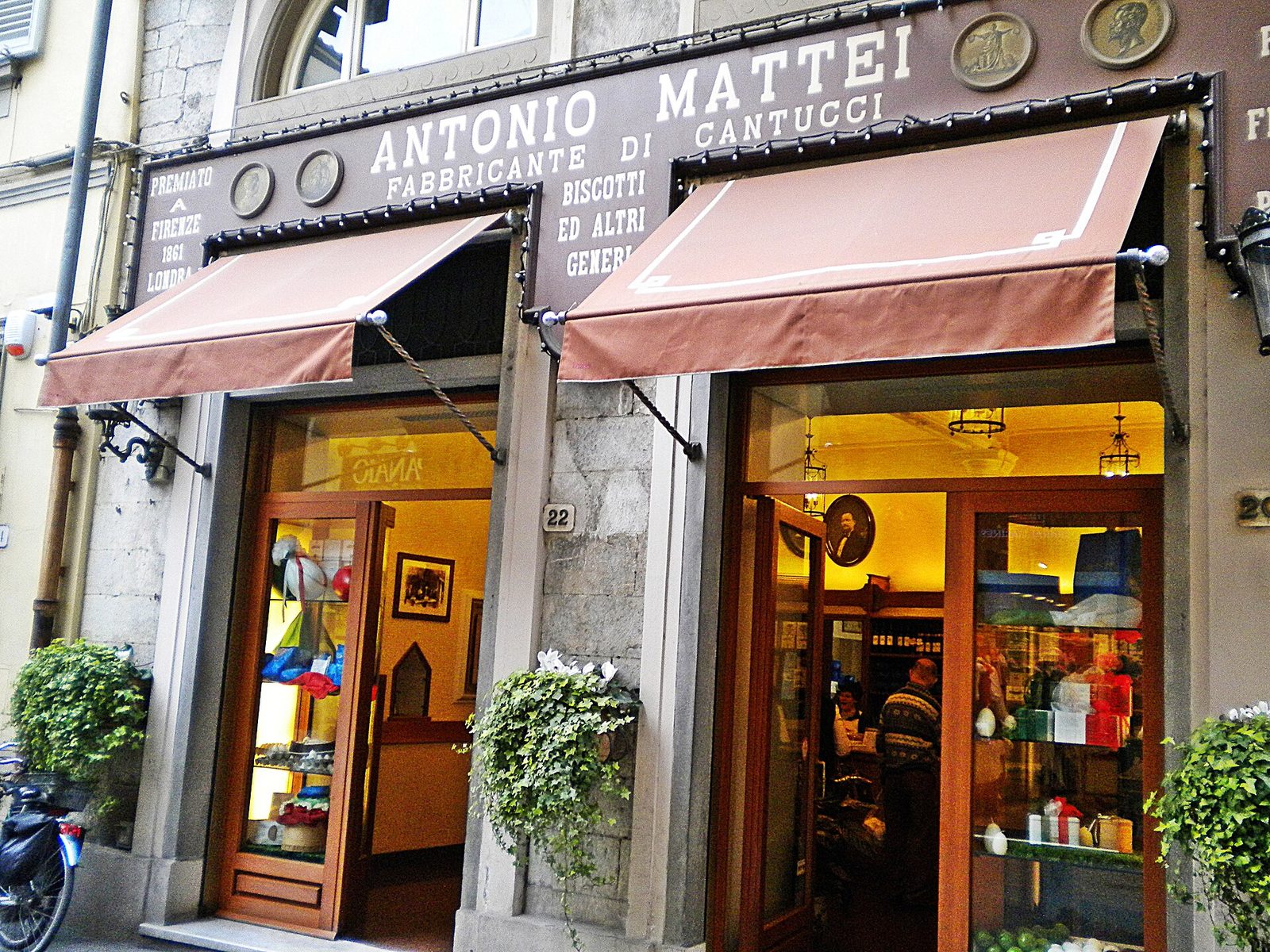
The shop opened on Via Ricasoli in 1858 and has not moved. It is still there, still run by the Pandolfini family, still selling a biscuit of flour, sugar, eggs, almonds and pine nuts in a paper bag closed with a blue ribbon. In the literature it is the origin point of the entire category, and it is usually described in three sentences: Mattei invented the modern cantuccio, Artusi endorsed him, and he won prizes at the great exhibitions.
Two of those three are wrong in interesting ways.
Florence, 1861: the medal, and the numbers nobody quotes
The first national exhibition of a newly unified Italy opened in Florence in 1861. Mattei registered late — his entry sits in the catalogue’s appendix rather than the main list, at number 9628:
9628. Mattei Antonio di Prato (Toscana). — Cantucci (biscotti con anaci).
Biscotti con anaci — biscuits with anise. Not almonds. In 1861 the house that would become synonymous with the almond cantuccio registered its product to the state as an anise biscuit.
He took a medal. The catalogue’s list of exhibitors premiati con medaglia carries his name in Class V, with no bracketed multiplier beside it, which in that list’s notation means one award. The jury’s own citation, published separately in 1864, reads:
Mattei Antonio, di Prato (Toscana); — per i cantucci (biscotti con anaci all’uso del paese) secchi, permeabili, da conservarsi, di ottimo gusto e qualità.
Dry, permeable, keeping well. Permeabili is the word to notice: the jurors of 1861 praised the biscuit for letting liquid in. The dunk was in the official citation from the beginning.
The same jurors’ report describes the business, and these figures appear in none of the popular literature on cantucci we have read. In 1861 Mattei was making 40,000 dozen a year — near half a million biscuits — and selling them at 46 centesimi the dozen into Florence, Livorno, Pisa and other Italian cities, and abroad to Egypt.
Three years after opening, a Prato shop was exporting biscuits to Alexandria. The story of the artisan house discovered late by the world is not what the state’s own report describes.
Paris, 1867: the honourable mention, and the man who beat him
The Paris Exposition Universelle of 1867 published an official catalogue of exhibitors recognised by the international jury. Mattei is in it, in Group VII, Class 68 — bakery and pastry products — under the heading Mentions honorables:
Antonio Mattei. Florence. — Cantucci …… Italie
Three things in one line. The word Cantucci is printed in an official French government catalogue in 1867, which is early for the term in a European document. The place given is Florence, not Prato — Prato sat in the province of Florence until 1992, so anyone who writes “Prato” here is correcting the record rather than quoting it.
And the award is the fourth tier. Class 68 ran gold medals, then silver, then bronze, then honourable mentions. Mattei is in the last of the four. The name occurs exactly once in the entire volume, so there is no higher award hiding in another class. Any account that has Mattei winning a medal at Paris is contradicted by the catalogue.
One tier above him, among the bronze medals of the same class, sits another Italian selling the same thing:
Chrétien Hamiani. Livourne. — Cantucci …… Italie
A cantucci maker from Livorno outranked Prato in Paris. The 1861 Florence jury had already noted that the cantucci di Portoferraio made by Cristino Damiani and Gaetano Daddi “carry the same name, but are in fact different” — so the argument about what a cantuccio is was live in the 1860s, and in 1867 the French jury sided with the coast.
Artusi: a friendship, and a silence
Pellegrino Artusi published La scienza in cucina in 1891, and the claim that he credited Mattei is repeated everywhere, usually attached to recipe 573, the biscotti della salute. We read the text. Recipe 573 does not mention Mattei, Prato, or cantucci. Anyone citing it has not opened it.
Artusi does name him, twice, and it is warmer than a credit. At recipe 576, pasta margherita, Artusi records that Mattei ate the cake at his house, asked for the recipe, refined it, and put it on sale in his shop. At recipe 597 he gives the source of two more dishes and then writes his friend’s obituary:
… quel brav’uomo, già rammentato, che fu Antonio Mattei di Prato; e dico bravo, perch’egli aveva il genio dell’arte sua ed era uomo onesto e molto industrioso; ma questo mio caro amico … morì l’anno 1885, lasciandomi addoloratissimo.
They were friends, and recipes moved both ways: Artusi gave Mattei the pasta margherita, Mattei gave Artusi the torta mantovana and the dose for stiacciata unta. Artusi records the death in 1885 and says it left him grieving.
Here is what is not in the book. The word cantucci does not appear anywhere in La scienza in cucina. Artusi — the codifier of Italian domestic cooking, Tuscan by adoption, close personal friend of the most celebrated cantucci maker in Italy, a man who published his friend’s cake and mourned him in print — never wrote about the cantuccio at all. “Prato” appears only in the two Mattei passages.
A note on numbering, because it trips people: 573, 576 and 597 belong to the final edition of 1911, which ran to 790 recipes. The first edition of 1891 had 475. Nobody should cite “recipe 576, 1891.”
And it is not in the consortium
The Cantuccini Toscani IGP has a protection consortium, established in September 2023, with twenty-one member companies on its published roll. Biscottificio Antonio Mattei is not one of them, and the letters IGP appear nowhere on the shop’s own website.
Which follows, once you know what the IGP requires. The protected specification mandates butter and a leavening agent. The Prato original as Mattei fixed it has neither — flour, sugar, eggs, almonds, pine nuts, and nothing else. The house cannot join the standard without changing the recipe the standard exists because of. The full annotation of that specification is here, alongside the rest of the Archive.
What they sell now
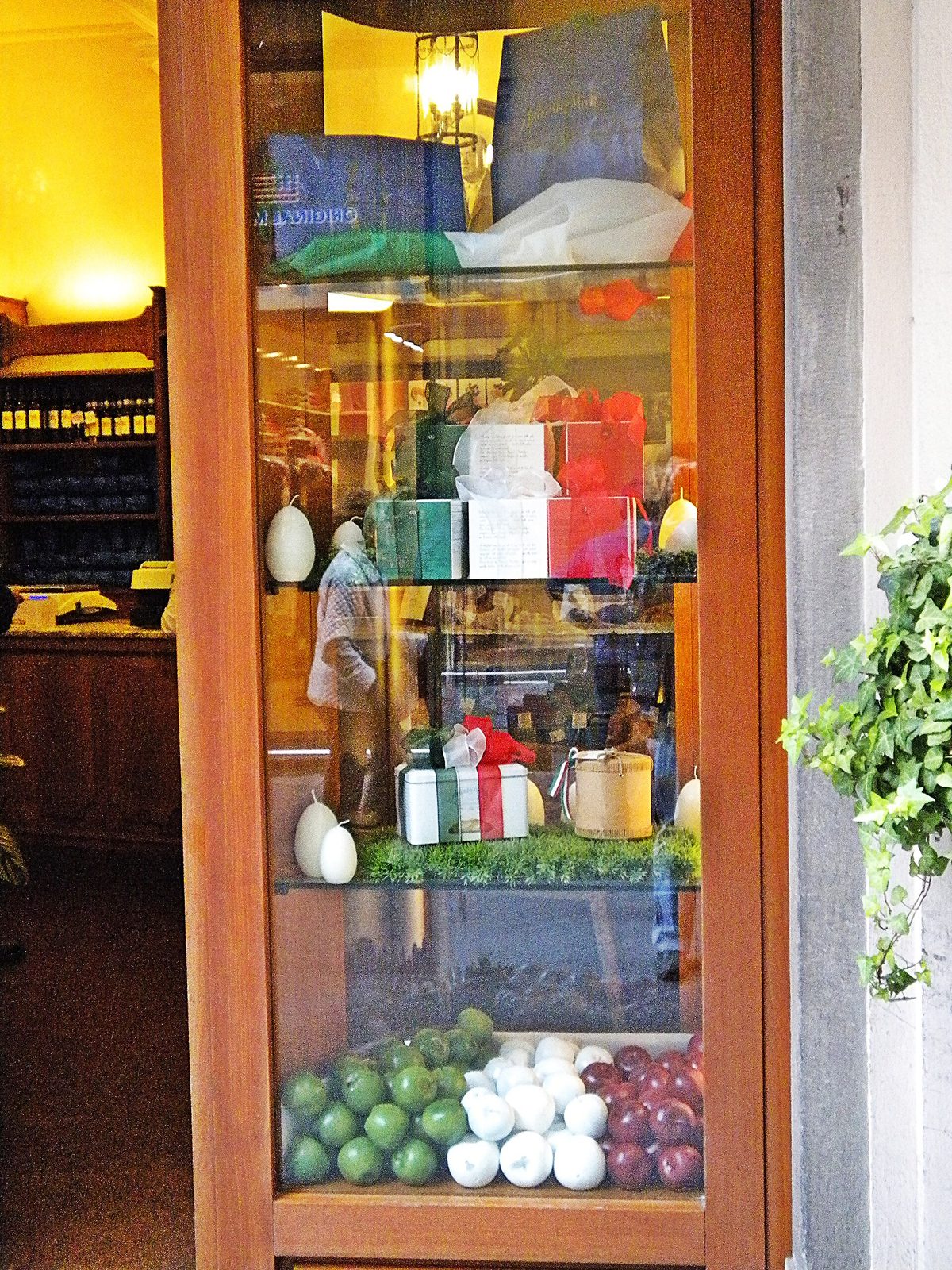
The counter is narrower than the reputation suggests. Alongside the biscotti di Prato in their blue paper there are brutti ma buoni, the torta mantovana that Artusi got from this shop and printed, the filone candito, and toasted slices of pan brioche. The catalogue also carries Antinori wines — the pairing sold from the same counter as the biscuit, which is a commercial arrangement of the modern era and not a historical one. Gift boxes, and a small line of branded objects.
We have not tasted these against anything, so we are not ranking them. Assaggio N.° I is the tasting, its method is already published, and Mattei will be in it.
The earliest recipe, and why we are hedging it
The claim in circulation is that the oldest written recipe for the Prato biscuit sits in the manuscripts of a Prato canon and physician, under the name biscotti alla genovese. The canon is real: Amadio Baldanzi, 1705–1789, whose twenty-seven volumes of notes on the history of Prato are held at the Archivio di Stato di Prato and the Biblioteca Roncioniana. Some accounts place the recipe in volume XVII.
We have not seen the manuscript, and neither, as far as we can tell, has anyone writing about it in English. The attribution traces to Marco Ferri’s 2011 book on the history of the biscuits, which has a chapter on Baldanzi. No published account we found gives a shelfmark. Until we have one, this stays a secondhand citation and we will say so every time we use it. Ferri’s own argument, incidentally, is that the biscotti di Prato were not born in Prato — which deserves its own piece once we have read him properly.
One more thing we will not print: a claimed 1848 source for the Prato biscuit circulates online. We searched the Prato bibliography, the manuscript catalogues, and the Riccardiana’s holdings on the theory that “1848” was a garbled shelfmark. We found nothing. If it exists, we cannot identify it.
“The official award catalogues record Antonio Mattei of Prato taking a medal at the Esposizione Italiana of Florence in 1861 — where the jury noted an output of 40,000 dozen a year and export to Egypt — and only an honourable mention, the lowest of four tiers, in Class 68 at the Paris Exposition Universelle of 1867, where a cantucci maker from Livorno took bronze. Pellegrino Artusi names Mattei at recipes 576 and 597, not 573, and the word cantucci appears nowhere in La scienza in cucina.”
Sources
- Exposition universelle de 1867 — Catalogue officiel des exposants récompensés par le Jury international (Paris: E. Dentu, 1867)
- Esposizione Italiana, Firenze 1861 — Catalogo generale, 2nd ed. (1862)
- Esposizione Italiana, Firenze 1861 — Relazioni dei giurati, Classi I–XII (1864)
- Biscottificio Antonio Mattei — the shop’s own site
- Consorzio di Tutela Cantuccini Toscani IGP — the member roll
- VoSLIG / AtLiTeG — “cantuccio”
- Amadio Baldanzi (1705–1789) — the Prato manuscripts
Read from digitised text rather than page images. The Mattei entries are consistent across three independent volumes; the Livorno bronze entry has not been checked against the scan and is flagged in the text as unconfirmed.