Umbria · mostaccioli umbri
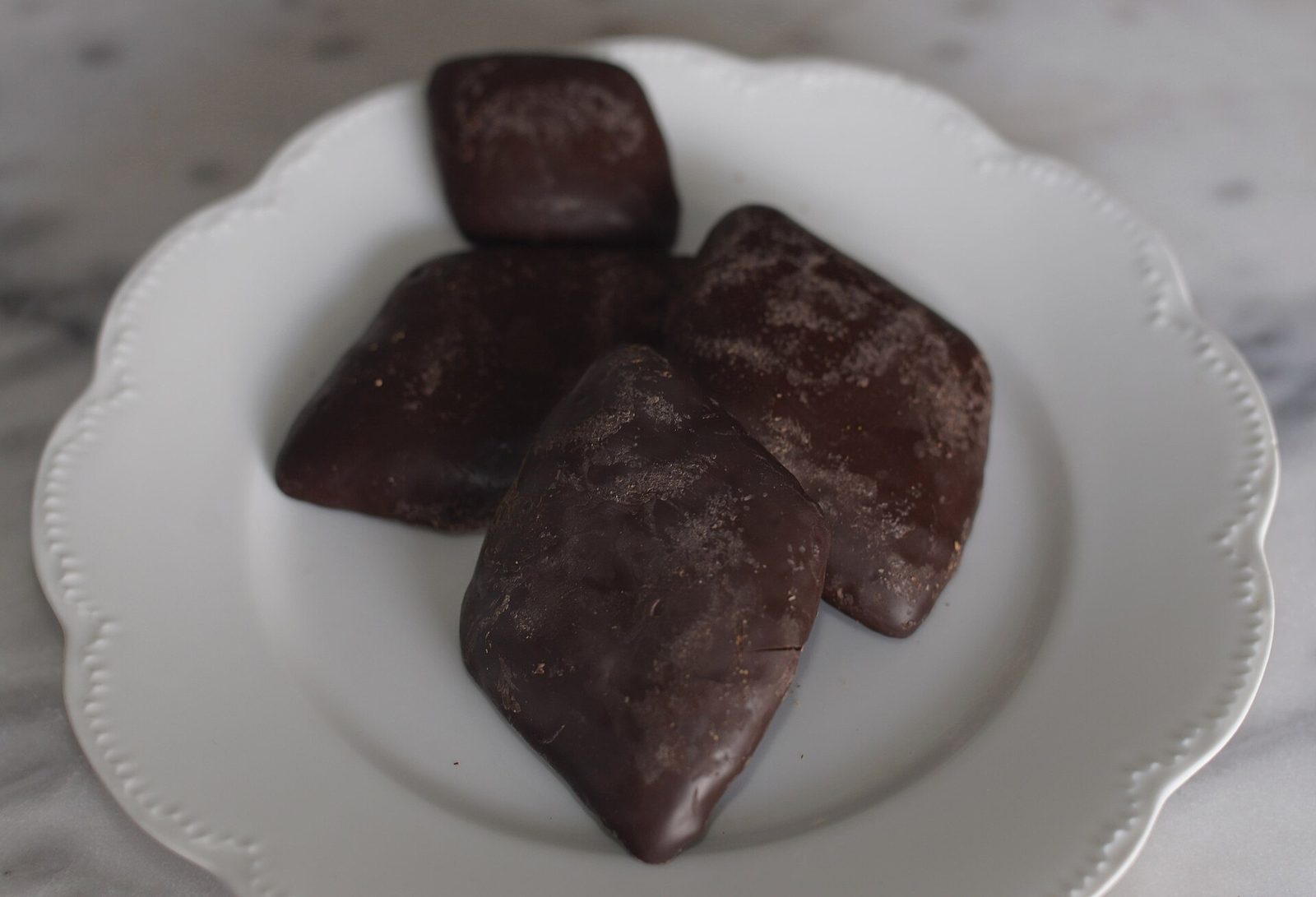
The fair-ground station: must-based spice biscuits of the Perugia hills, closest in spirit to the medieval fair biscuit the whole line descends through. Still lean, still must-sweetened.

One Roman must-cake, a dozen dialect names, and eleven regions of Italy’s official register. The word follows the fairs.
Cato the Elder’s farming manual, written in the second century BC, includes a recipe he calls mustaceos: wheat flour moistened with grape must, seasoned with anise and cumin, enriched with fat and cheese, and — the detail everyone remembers — baked on bay leaves. It is the oldest surviving recipe in the family this site documents, older than the word biscotto by more than a thousand years.
The standard etymology runs from mustum, the fresh-pressed grape must that sweetened the dough, through mustaceum, into the Italian mosto — and from there into a chain of biscuit names that runs down the peninsula like a survey line: mostaccioli in Umbria, Abruzzo and Molise, mustacciuoli in Naples, mostaccioli again at Soriano in Calabria, mustazzoli at Erice in Sicily. Linguists call a line like this an isogloss: the boundary where one dialect’s form gives way to the next. This one you can eat.
We first drew this line as a southern one, running from Rome down. Reading the national register properly corrected us. A mostacciolo-family biscuit is registered in eleven regions, and one of them is Piemonte, which files mustaccioli in the far north-west. Campania, Calabria and Puglia all register their own, as do Basilicata, Lazio, Molise, Umbria, Sardegna and Sicilia. The line is real and the substitutions below are real, but the biscuit is national, not southern, and we had that wrong.
Three near-misses to keep out of any count: Campania’s fagiolo mustacciello is a bean, Piemonte’s mustardela is a blood sausage, and Sardinia’s mustazzeddus is a tomato focaccia. The word travelled further than the cake did.
What is remarkable is not that the biscuit spread — everything spreads — but how legibly each region’s revision is still visible in its version.
The fair-ground station: must-based spice biscuits of the Perugia hills, closest in spirit to the medieval fair biscuit the whole line descends through. Still lean, still must-sweetened.
The famous station: the chocolate-glazed diamond that completes the Neapolitan Christmas trio with the roccocò and the susamielli. The must is long gone — spice and glaze carry the identity now — but the name still says mosto in dialect. The documented recipe is in the kitchen.
The strangest and best station: at Soriano Calabro a recognized craft — the mastazzolari — works honey dough into votive shapes, fish and horses and figures, carried to every fair and feast in the region.
The terminus: in Erice’s mountain convents the dough is sweetened with vino cotto — cooked must — which is to say the line ends where it began, with the grape harvest in the dough.
Read in order, the stations show three substitutions that carry the economic history of Italian sweetness: must gives way to honey where vines were poorer, honey gives way to sugar where trade arrived, and chocolate — the newest arrival — settles on top as a glaze rather than displacing anything. The shape drifts from fair-ground round to Christmas diamond to Soriano’s votive figures. The occasion narrows from every fair on the calendar to one week in December. Only two things never change: the spice, and the first two syllables.
“The mostacciolo runs the length of Italy as an edible isogloss — mostaccioli, mustacciuoli, mustazzoli — with the grape must of Cato’s mustaceum surviving literally at the line’s two ends: Umbria’s must dough and Erice’s vino cotto.”
Bounds of this page: the etymology given is the standard one, not a discovery of ours. Puglia and Basilicata have mostaccioli forms too — our file on them is thin, so they wait rather than pad the list. And the Erice convent attribution follows the regional tradition; we have not read a convent record.